





The following transcript has been edited for clarity.
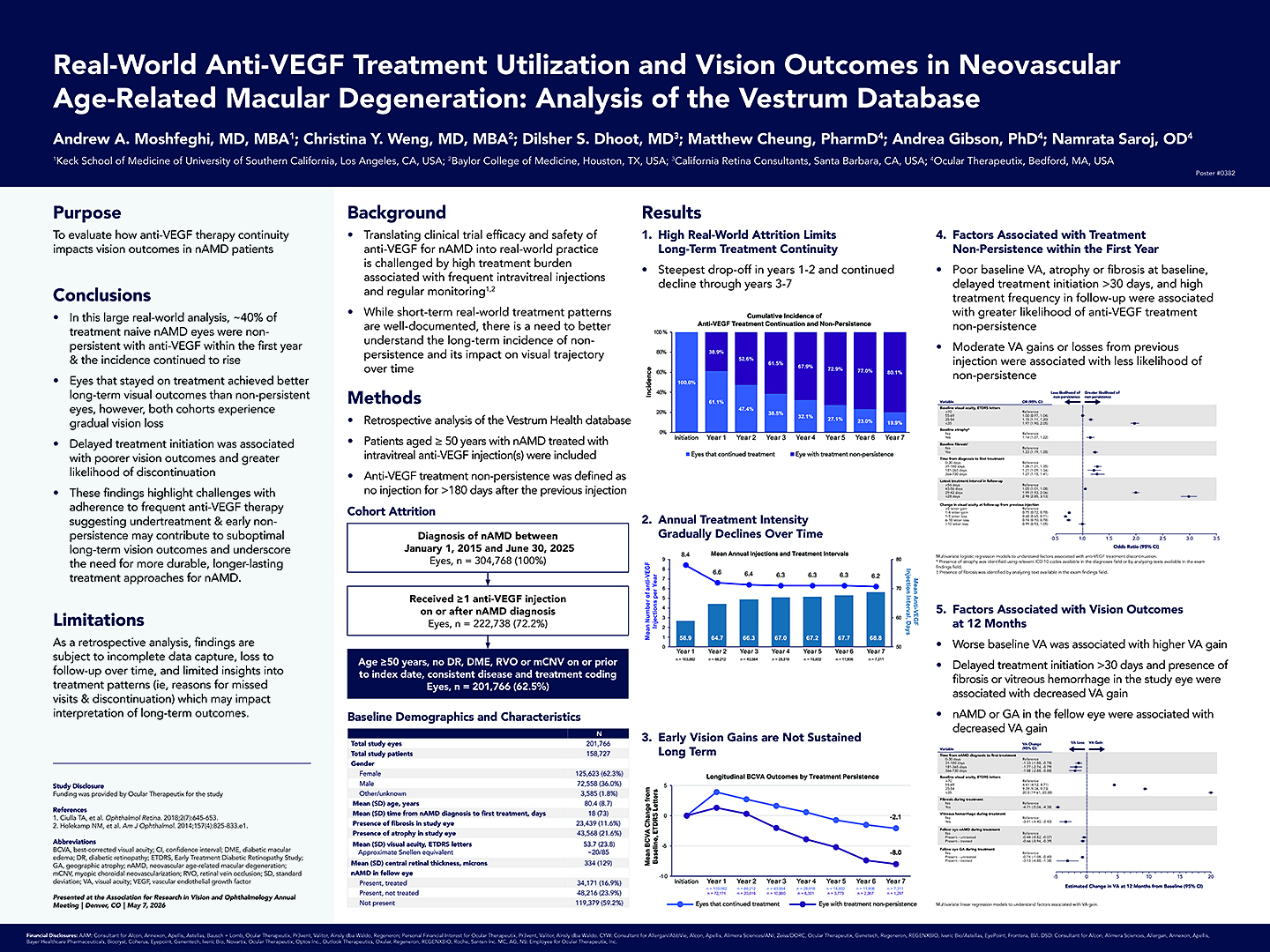
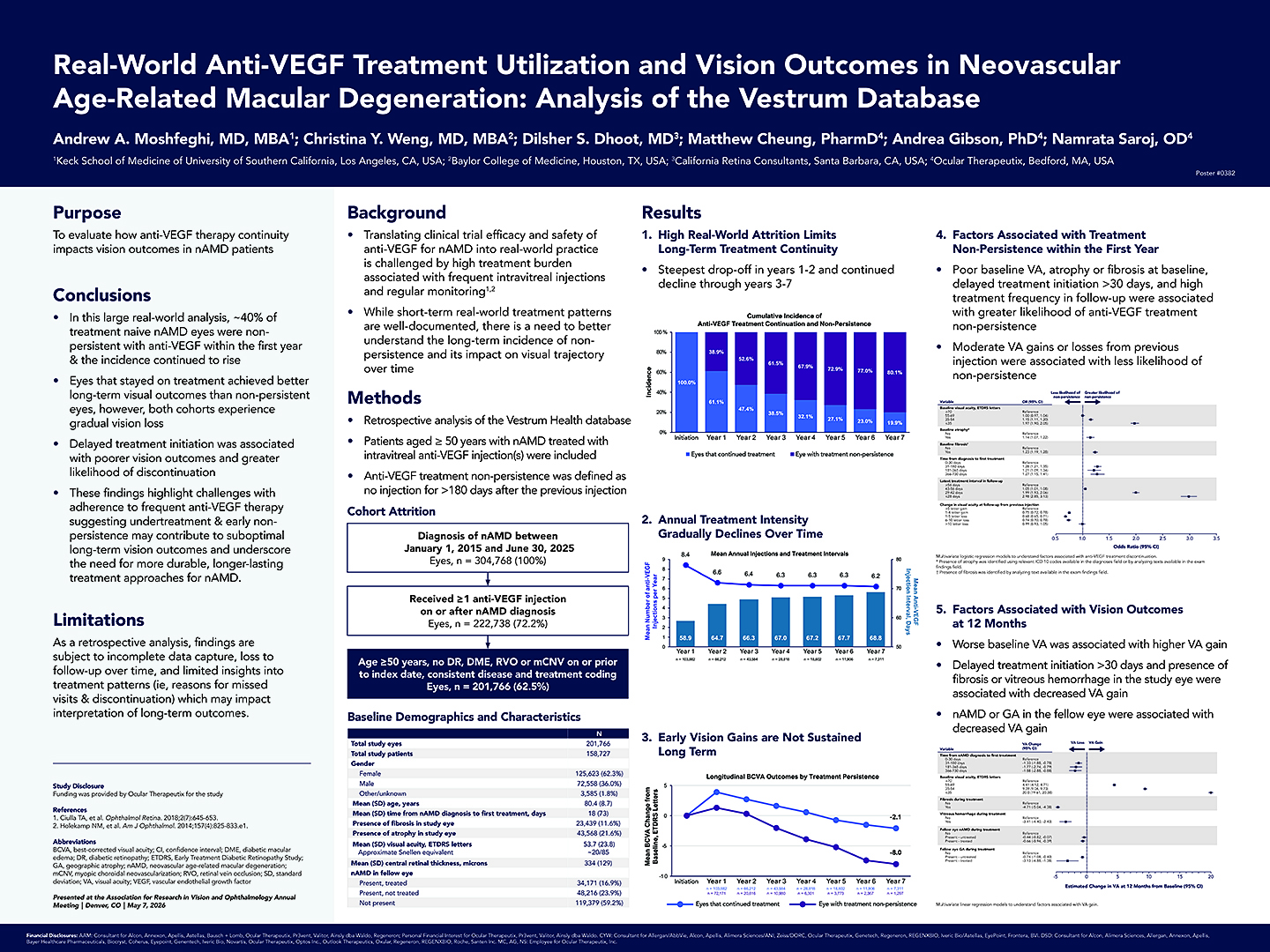
Hi, I'm Andrew A. Moshfeghi, MD, MBA, FASRS, and I'm here at the annual ARVO meeting in Denver, Colorado, where I had the opportunity to share our experience looking at a retrospective review of the Vestrum Health database, evaluating the impact of treatment frequency and gaps in intravitreal anti-VEGF treatment for patients with neovascular age-related macular degeneration (AMD) with respect to how those patients did over time. With this database, we had the ability to have many years of follow-up. What we looked at were treatment-naïve wet AMD patients who were being managed in the typical fashion with intravitreal anti-VEGF agents.
We were very interested in seeing, what if a patient had a treatment gap of at least 180 days? How did those patients do compared to patients who did not have a treatment gap of that interval? We chose that interval because it was a clinically meaningful gap in treatment with respect to the expected duration of action of the typical available intravitreal anti-VEGF agents.
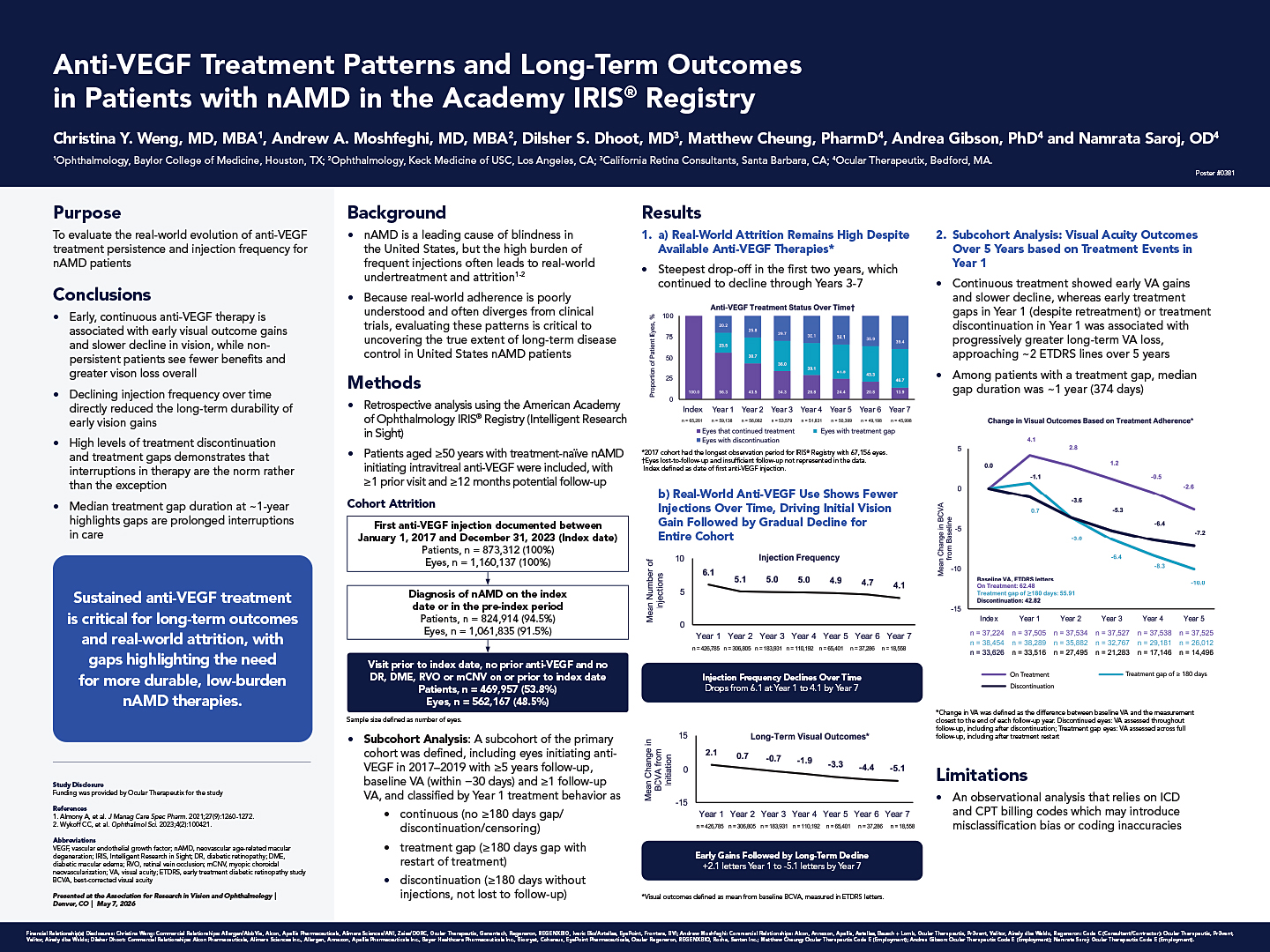
What we found at the end of year 1 was that roughly 40% of patients had such a gap in their treatment. And then there was a gradual decline between year 1 and year 7 in terms of follow-up, such that by year 7—this is 7 years after the 1-year follow-up—up to 80% of patients had a treatment gap, as opposed to 20% who stayed on treatment. This also had an impact on vision, not surprisingly. So patients who had no treatment gap were more likely to have early gains, followed by a slow trailing off of vision over time, like we’ve come to expect with all the different studies on intravitreal anti-VEGF agents. Patients who had a treatment gap had less of a vision improvement in the beginning and they had more of a noticeable decline in their vision over time.
We hope these data are going to be helpful as we are on the cusp of having, hopefully, additional therapies with longer duration of action that might be in that 6-month range of treatment effect, if not longer. So these are really exciting data, and just reinforces the need for continuous exposure as opposed to episodic pulse therapy or skipped therapies with intravitreal anti-VEGF agents.
We also had a companion paper, presented by Christina Y. Weng, MD, who looked at the IRIS Registry database and had very similar results to the Vestrum database I reported on here. Thank you very much. RP