





In geographic atrophy (GA), approved therapies can slow disease progression but cannot restore lost vision. The current therapeutic approach has therefore focused on preservation, rather than recovery, of retinal structure or function. In a clinical trial that is currently under way, investigators are exploring a different strategy: whether damaged retinal tissue can regain function following transplantation of retinal pigment epithelium (RPE) cells derived from human embryonic stem cells.
Vivienne S. Hau, MD, PhD, of the Kaiser Permanente Bernard J. Tyson School of Medicine, presented preliminary data on the investigational therapy, ASP7317 (Astellas Pharma) during the 2026 meeting of the Association for Research in Vision and Ophthalmology (ARVO) in Denver (Figure 1). “For perhaps the first time, we are beginning to explore whether damaged AMD retina may not only be preserved, but partially restored through regenerative stem cell therapy,” she explained.

Figure 1. ASP7317 is an investigational retinal pigment epithelium cell therapy derived from human embryonic stem cells and designed to restore retinal support through trophic signaling, cellular communication, and phagocytic RPE function.
Dr. Hau reported findings from 14 patients with advanced GA enrolled in the phase 1b open-label, dose-escalation study. Enrollment was limited to patients with severe vision impairment and GA lesions measuring 30.5 mm² or smaller. Patients were divided into low-dose (n=3), medium-dose (n=5), and high-dose (n=6) cohorts. The patients underwent pars plana vitrectomy followed by subretinal transplantation of ASP7317.
At 26 weeks, treated eyes demonstrated improvements in best-corrected visual acuity (BCVA) across all ASP7317 dose cohorts, while untreated fellow eyes generally declined. Mean BCVA change from baseline in treated eyes was +10.5 letters in the low-dose cohort, +7.25 letters in the medium-dose cohort, and +4.25 letters in the high-dose cohort, compared with -4.0, -5.65, and +2.56 letters, respectively, in fellow untreated eyes (Figure 2).

Figure 2. At 26 weeks, ASP7317-treated eyes demonstrated BCVA gains across dose cohorts, whereas untreated fellow eyes generally remained stable or declined.
At 52 weeks, visual gains appeared to persist in the cohorts with available follow-up data. Mean BCVA change from baseline was +5.5 letters in treated eyes in the low-dose cohort and +9.08 letters in the medium-dose cohort, compared with -2.5 and -5.75 letters, respectively, in untreated fellow eyes. Patients in the high-dose cohort had not yet reached the 52-week follow-up time point (Figure 3).
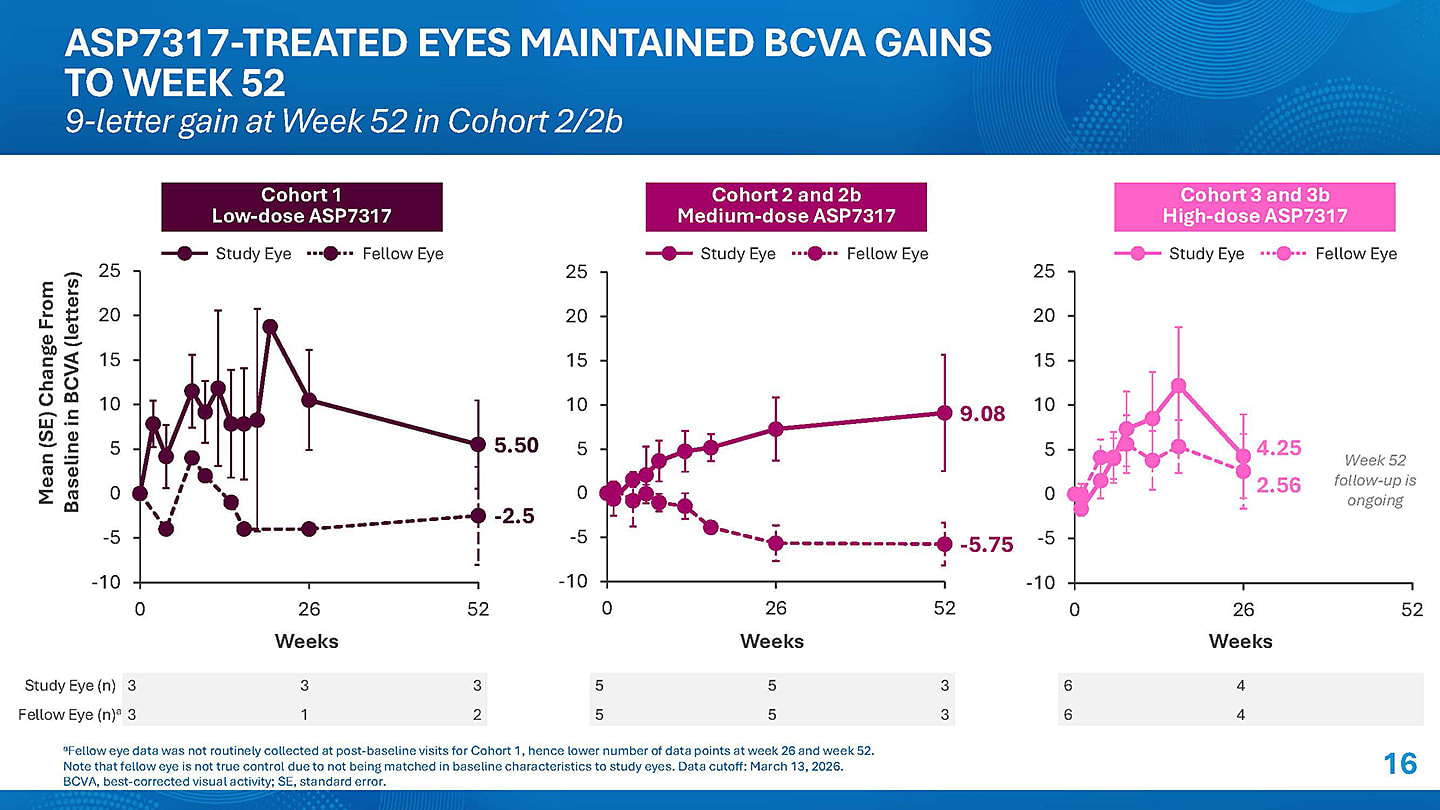
Figure 3. ASP7317-treated eyes maintained improvements in best-corrected visual acuity through week 52, with patients in the medium-dose cohort demonstrating a mean gain of 9 letters.
Investigators also evaluated anatomic outcomes using spectral-domain optical coherence tomography and fundus autofluorescence imaging. GA lesion size appeared generally stable in treated eyes, with imaging suggesting preservation of outer retinal structures, including the ellipsoid zone (Figure 4). Fellow untreated eyes typically demonstrated stable or progressive degeneration consistent with unchanged or worsening visual function.
The study included perioperative immune modulation and closely monitored safety outcomes. No signs of immune rejection, abnormal cell growth, transplant failure, inflammation inside the eye, or pressure-related complications were reported. One serious adverse event, epiretinal membrane progression to proliferative vitreoretinopathy, occurred in a patient in the low-dose cohort.

Figure 4. Eyes treated with ASP7317 demonstrated stabilization of geographic atrophy lesion area, whereas untreated fellow eyes showed continued progression.
While this study is early and ongoing, the findings point to a shift in treatment approach for advanced GA. “For decades, AMD therapy has focused primarily on slowing degeneration,” Dr. Hau said. “Regenerative stem cell therapy introduces the unprecedented possibility of restoring cellular support and potentially improving visual function in damaged retina.” RP