



The use of wearable devices for health monitoring has attracted significant interest from patients, physicians, and other healthcare professionals because of their potential to usher in a new era of personalized, accessible, and convenient care. The wearable medical device industry is currently valued at more than $100 billion and is projected to exceed $300 billion by 2032.¹
This article explores the use of wearable technology for monitoring retinal health, both through direct assessment of ocular parameters—such as visual field testing and imaging—and through systemic monitoring of surrogate markers of retinal health.
Visual Field Testing
The use of wearable virtual reality (VR) headsets for visual field testing has been repeatedly investigated.2 VR-based perimetry offers some advantages over conventional methods, including lower cost and increased accessibility. However, VR-based perimetry remains a nascent technology with notable limitations. Because of a lack of technical standardization, device capabilities may vary, but common technical challenges include inadequate luminance and threshold sensitivities as well as insufficiently advanced eye-tracking technology.3,4 Patients may also initially find VR-based perimetry more difficult to use due to unfamiliarity with the devices.
Despite these limitations, VR-based perimetry holds potential for developing easier and more intuitive techniques for visual field testing. For example, when a patient breaks fixation on the intended central target, an arrow could be overlaid in virtual space connecting their gaze to the target, intuitively correcting fixation. Furthermore, with sufficiently advanced eye-tracking technology, a VR-based perimeter could continuously monitor a patient’s gaze and render visual field targets relative to their fixation point, potentially improving testing speed and validity.

Figure 1. The OcuLenz AR/XR headset, designed for patients with advanced age-related macular degeneration, uses high-resolution, widefield overlays to shift central vision imagery to the peripheral retina, enhancing visual perception and interaction.
Augmented Reality Headsets
In addition to using wearable technology to detect retinal defects, the therapeutic potential of wearable technology has also been explored. For example, OcuLenz (Ocutrx Technologies) is an augmented reality (AR) headset designed to address central scotomas in age-related macular degeneration (AMD). After performing visual field testing to identify affected retinal areas, the device (Figure 1) employs modified real-time streaming video to assist vision.5 Specifically, the onboard video feed is manipulated in real time so that imagery is shifted away from the central scotoma and integrated into immediately adjacent areas, optimizing use of the remaining functional vision.
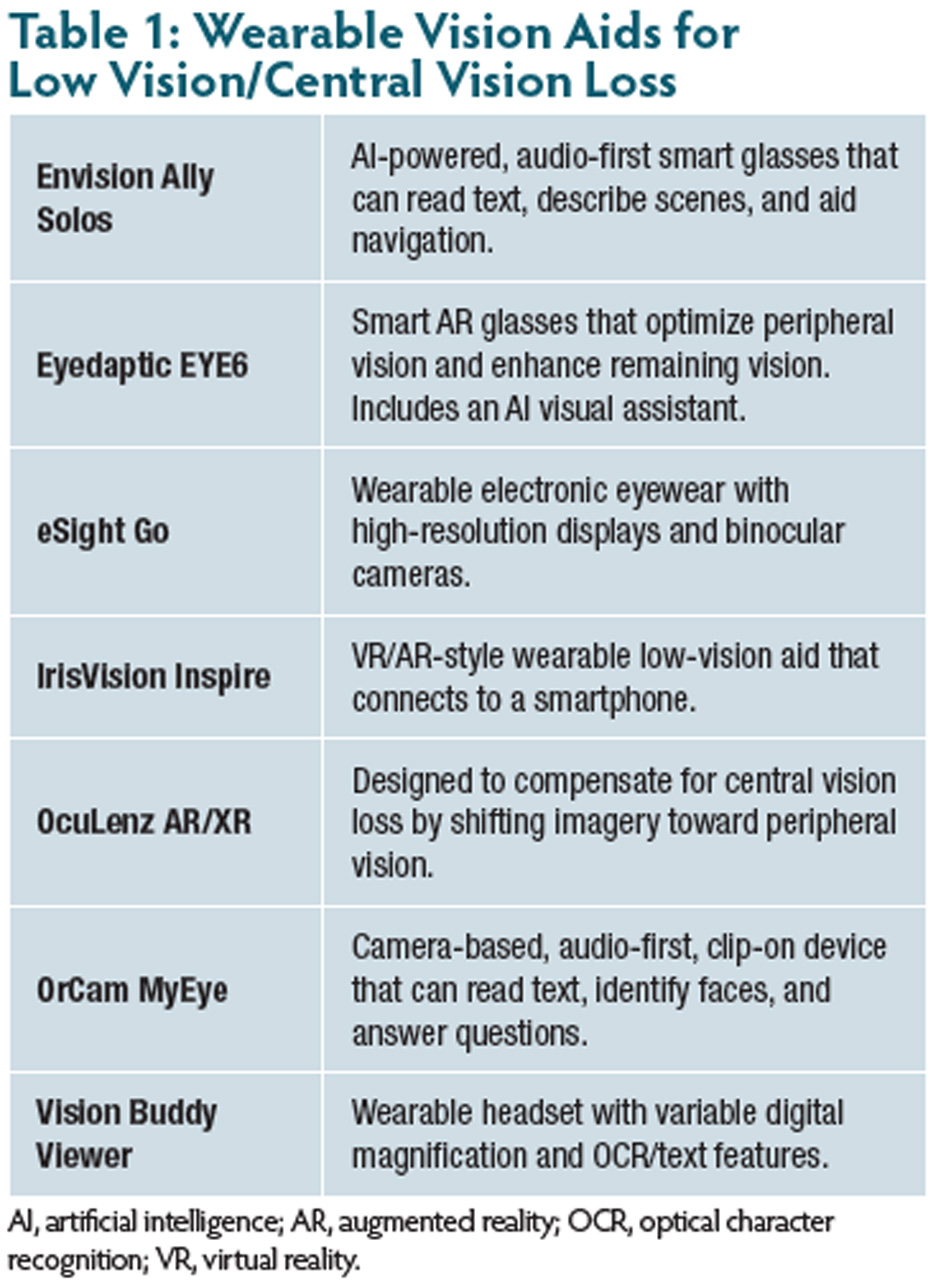
Wearable assistive technology to help patients read or watch television has been available since 2013, when eSight Eyewear released a device that used high-definition cameras to capture real-time images. These were processed and displayed on high-resolution screens in front of the user’s eyes, making it easier to see details. Since then, similar devices have been provided by companies like Eyedaptic, IrisVision, and OrCam Technologies (Table 1). Improvements in AR and VR technologies, as well as artificial intelligence, have enabled many new features for low-vision wearables, from enlarging fonts to improving image contrast.
Wearable Fundus Imaging
Researchers at the Johns Hopkins Wilmer Eye Institute and the Johns Hopkins Applied Physics Laboratory have begun investigating head-mounted fundus imaging technology, nicknamed “retinal selfies.”6 Although this research remains in the early stages of development, the ultimate goal is to create a device similar in size to eyeglasses or a virtual reality headset that can capture fundus images.
Key technological innovations in the project include the use of transscleral illumination and metaoptics (also known as flat optics), in which ultrathin, microscopic nanostructures are used to manipulate light.7 If successful, these wearable devices could not only dramatically improve screening for ocular disease but also potentially enhance detection of systemic diseases with ocular manifestations, including cardiovascular, infectious, and hematologic disorders.8

Figure 2. The Neuro-i SS-OCT (JuneBrain) is a head-mounted, swept-source optical coherence tomography device designed to capture high-resolution retinal images. It is not yet commercially available.
Wearable OCT Imaging
Few tools are as effective for monitoring retinal health as optical coherence tomography (OCT) imaging. Conventional OCT devices are relatively fixed and immobile, requiring patients to travel to ophthalmology clinics for imaging. This can present challenges, particularly for patients with limited mobility or when transportation to a clinic is difficult.
The development of head-mounted, wearable OCT devices seeks to address these limitations and improve both accessibility and patient comfort. For example, the commercial venture JuneBrain aims to miniaturize the hardware required for swept-source OCT (SS-OCT) and package it into a VR-like headset that is mounted on the face and secured with head straps (Figure 2).9
In addition to increasing accessibility within medical facilities, wearable OCT devices could dramatically expand access outside the clinic. For instance, a device could be shipped to a patient’s home, used to capture OCT images that are remotely read by a provider, and then returned for use by another patient.
Like wearable fundus imaging technologies, successful development of wearable OCT devices could also improve screening for systemic diseases with ocular manifestations. Conditions detectable on OCT include, but are not limited to, cardiovascular disease, neurodegenerative disease, neoplastic disease, and infectious disease.10
Systemic Health Monitoring
Although significant progress has been made in wearable ocular technologies, numerous advances have also occurred over the past few decades in general health-monitoring wearables. Some of these devices are nonmedical, consumer- facing products, whereas others are medical devices that have been successfully adopted for routine daily use.

Figure 3. The Dexcom G7, a wearable patch that can be monitored with a smartphone or watch, is an example of a continuous glucose monitoring (CGM) device. Image © 2026 Dexcom, Inc. Used with permission.
Diabetic Monitoring
Diabetes mellitus is a well-established cause of retinal disease. Tight glucose control has long been a cornerstone in managing diabetic retinopathy, and patients have traditionally used point-of-care (POC) blood glucose testing devices. Although POC testing provides valuable insight into daily glucose fluctuations, continuous glucose monitoring (CGM) technology has further increased the frequency and ease of data acquisition. The first CGM device was FDA-approved in 1999; however, it collected data for only 3 days, and data access was limited to retrospective analysis.11 Over the past decade, technological advances have allowed CGM devices to provide real-time monitoring via smartphones (Figure 3) and to be factory-calibrated, eliminating the need for patient calibration with blood glucose readings.
Although wearable CGM devices do not monitor retinal health directly, their use is associated with a lower risk of diabetic retinopathy.12 Moreover, established correlations exist between CGM metrics—such as time in target range, time in tight target range, and time above range—and incident risk of diabetic retinopathy. Therefore, CGM devices may serve as an important surrogate measure of long-term retinal health.
Hypertensive Monitoring
Hypertensive retinopathy is a common retinal disease in which wearable health-monitoring devices may play a vital role. Survey data from the National Center for Health Statistics (NCHS) indicate that 47.7% of US adults have hypertension, and among them, only 59.2% are aware of their condition.13 Furthermore, Erden and Bicakci reported that the prevalence of hypertensive retinopathy among patients with hypertension was 66.3%.14 Given the prevalence, often asymptomatic nature, and potential severity of hypertension, many wearable device manufacturers—both within and outside of medicine—have focused research and development efforts on continuous, noninvasive blood pressure monitoring.
Most consumer-grade wearable devices use photoplethysmography (PPG) to estimate cardiovascular parameters. Infrared light is emitted, reflected by the skin, and analyzed to estimate heart rate and, more recently, blood pressure.15 Currently, PPG cannot directly report systolic or diastolic blood pressures. However, Apple has developed deep learning–based algorithms that use continuous PPG data to screen individuals at risk of chronic hypertension. These algorithms were successfully FDA-cleared in September 2025 after validation in a clinical trial of more than 2,000 participants.16-17 Therefore, although wearable devices cannot directly detect arteriolar narrowing, copper wiring, or arteriovenous nicking in retinal vessels, their use for systemic hypertension screening may enhance population-level detection of hypertensive retinopathy.
Intraocular Pressure Monitoring
In addition to monitoring conventional retinal health parameters, much research in ocular wearable technology has focused on measuring intraocular pressure (IOP). For example, soft contact lenses have been developed with metallic elements whose electromagnetic properties vary with mechanical strain, such as corneal deformations caused by IOP fluctuations. When combined with a separate, contact-free sensor, these technologies may allow minimally invasive, continuous IOP measurement.18 However, acquisition of more detailed retinal health metrics remains limited, particularly regarding rich and clinically relevant retinal imaging.
Conclusion
The use of wearable devices for direct and indirect monitoring of retinal health remains an important research goal. Technologies for direct ocular health monitoring are still relatively nascent and require further iteration and refinement before widespread clinical adoption. In addition to technical challenges, novel medical devices must navigate regulatory hurdles before becoming available in practice. In contrast, many wearable devices for monitoring systemic health markers have demonstrated both medical and commercial success. These widely used consumer-grade tools may play an important role in the indirect monitoring of retinal health while the healthcare industry awaits the maturation of viable wearable technologies for direct retinal monitoring. RP


References
1. Fortune Business Insights. Wearable Medical Devices Market Size, Share, Growth. November 24, 2025. Accessed December 11, 2025. https://www.fortunebusinessinsights.com/industry-reports/wearable-medical-devices-market-101070
2. Hekmatjah N, Chibututu C, Han Y, Keenan JD, Oatts JT. Virtual reality perimetry compared to standard automated perimetry in adults with glaucoma: A systematic review. PLoS One. 2025;20(1):e0318074. doi:10.1371/journal.pone.0318074
3. Babel AT, Soumakieh MM, Chen AY, Wong C, R da Costa D, Almeida DRP. Virtual reality visual field testing in glaucoma: benefits and drawbacks. Clin Ophthalmol. 2025;19:933-937. doi:10.2147/OPTH.S511803
4. Lee C, Redden L, Eng V, Eadie B. Luminance and thresholding limitations of virtual reality headsets for visual field testing. PLoS One. 2025;20(9):e0332795. doi:10.1371/journal.pone.0332795
5. Lam LA, Finley TA. Augmented reality device OcuLenz—role in improving functional vision in patients with age-related macular degeneration. Presented at: 2020 American Society of Retina Specialists (ASRS) annual meeting; July 24-28, 2020; Seattle, WA.
6. Raj A, Fischer R. “Retinal selfies” may provide window on health. Giving to Johns Hopkins. October 29, 2025. Accessed December 11, 2025. https://giving.jhu.edu/story/retinal-selfies
7. Johns Hopkins University. “Retinal selfies” may provide window on health. YouTube. October 24, 2025. Accessed December 11, 2025. https://www.youtube.com/watch?v=ry9qbu5qhW8
8. Kumar MJ Jr, Kotak PS, Acharya S, Nelakuditi M, Parepalli A. A comprehensive review of ocular manifestations in systemic diseases. Cureus. 2024;16(7):e65693. doi:10.7759/cureus.65693
9. JuneBrain. Neuro-i SS-OCT. Accessed December 11, 2025. https://www.junebrain.com/neuro-i
10. Merriott DJ, Parikh D, Najac MJ, et al. Optical coherence tomography and optical coherence tomography angiography in systemic disease. Taiwan J Ophthalmol. 2025;15(3):364-377. doi:10.4103/tjo.TJO-D-25-00053
11. Hirsch IB. Introduction: history of glucose monitoring. In: Role of Continuous Glucose Monitoring in Diabetes Treatment. Arlington (VA): American Diabetes Association, 2018. https://www.ncbi.nlm.nih.gov/books/NBK538968/
12. Liu TYA, Shpigel J, Khan F, et al. Use of diabetes technologies and retinopathy in adults with type 1 diabetes. JAMA Netw Open. 2024;7(3):e240728. doi:10.1001/jamanetworkopen.2024.0728
13. Fryar CD, Kit B, Carroll MD, Afful J. Hypertension prevalence, awareness, treatment, and control among adults age 18 and older: United States, August 2021-August 2023. NCHS Data Brief. 2024;(511):CS354233.
14. Erden S, Bicakci E. Hypertensive retinopathy: incidence, risk factors, and comorbidities. Clin Exp Hypertens. 2012;34(6):397-401. doi:10.3109/10641963.2012.663028
15. Li X, Hussein R, Zhu G, et al. Continuous blood pressure monitoring and hypertension risk screening using smart watch. Annu Int Conf IEEE Eng Med Biol Soc. 2024;2024:1-6. doi:10.1109/EMBC53108.2024.10782190
16. Browning S. Hypertension notification feature (HTNF). September 12, 2025. Accessed December 11, 2025. https://www.accessdata.fda.gov/cdrh_docs/pdf25/K250507.pdf
17. Apple Inc. Hypertension notification feature on Apple watch. September 2025. Accessed November 9, 2025. https://www.apple.com/health/pdf/Hypertension_Notifications_Validation_Paper_September_2025.pdf
18. Xu J, Li R, Xu H, Yang Y, Zhang S, Ren T. Recent progress of continuous intraocular pressure monitoring. Nano Select. 2021;3(1):1-19. doi:https://doi.org/10.1002/nano.202100137