


The Atlantic Coast Retina Club and Macula 2026 conference, held January 8-10, 2026, in Philadelphia, served as a dynamic kickoff to the year’s retina meetings, marking the 50th year for this long-standing educational forum. Organized by Yoshihiro Yonekawa, MD, Carl D. Regillo, MD, Allen C. Ho, MD, Julia A. Haller, MD, Carol L. Shields, MD, and Arunan Sivalingam, MD, of Wills Eye Hospital, and Alexander J. Brucker, MD, of the Scheie Eye Institute, the meeting featured 2 days of mystery case presentations by residents, fellows, and faculty. The third day, Macula 2026, included lectures from leading figures in retina, covering topics such as advances in age-related macular degeneration (AMD) and diabetic macular edema (DME), surgical techniques, oncology, uveitis, and pediatric retina. Below are selected highlights from the meeting.
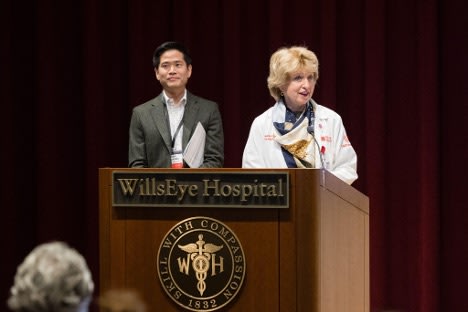
Atlantic Coast Retina Club and Macula 2026 Conference co-organizer Yoshihiro Yonekawa, MD, (left) with Julia A. Haller, MD, the CEO and ophthalmologist-in-chief of Wills Eye Hospital in Philadelphia. Dr. Haller was among 5 respected physicians honored for their contributions to the field of retina during the meeting. Photo by Kevin Caldwell.
Ocular Tumors
Friday included 2 sessions focused on ocular oncology and tumor cases, novel treatments, and potential side effects of treatments. Notable presentations included a case of bilateral retinoblastoma by David H. Abramson, MD, in which systemic cell-free DNA was shown to drop significantly following enucleation of an eye with no light perception. This finding supported a decision to avoid systemic chemotherapy and opt for intra-arterial chemotherapy in the fellow eye, with the patient remaining metastasis free. Another case demonstrating the effectiveness of intra-arterial chemotherapy was presented by Sara Lally, MD, who discussed metastatic cutaneous melanoma in the subretinal space that was successfully treated after 4 treatment sessions.
A presentation by Jasmine H. Francis, MD, FACS, sparked discussion around an elderly patient with type 2 diabetes who presented with choroidal thickening and retinal fluid. A lymph node biopsy showed no malignant cells, and imaging findings remained stable. Therefore, a decision was made to discontinue the patient’s diabetes treatment with dulaglutide, rather than treating the condition as cancer. The symptoms subsequently resolved, underscoring the need for further understanding of the ocular side effects of GLP-1 receptor agonists.
Carol L. Shields, MD, presented a case of vitreous hemorrhage with Coats disease–like changes. Similar findings in the fellow eye raised suspicion for a systemic condition. The patient was also noted to have dyskeratosis of the tongue, and subsequent testing confirmed a diagnosis of dyskeratosis congenita, a rare telomere biology disorder. This case highlighted the importance of looking for signs and symptoms beyond the eye.
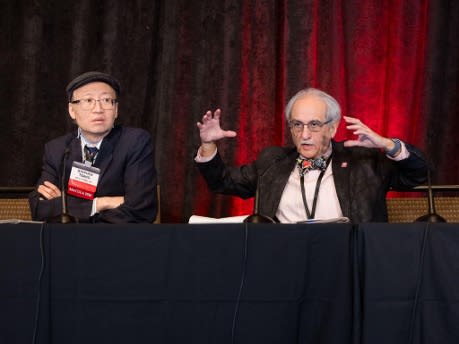
Stephen H. Tsang, MD, PhD, (left) and Jose S. Pulido, MD, discussed inherited retinal diseases during the Atlantic Coast Retina Club and Macula 2026 conference. Photo by Kevin Caldwell.
Inherited Retinal Diseases
Mystery faculty cases continued with an engaging session presented by experts in inherited retinal diseases (IRDs), emphasizing how diagnosis and management may evolve following inflammation, trauma, or incomplete genetic characterization. Diogo Cabral, MD, drew attention to inflammatory mimickers of common retinal diseases, presenting a central serous chorioretinopathy–like fundus appearance in which multimodal imaging and ancillary testing revealed lupus choroidopathy.
Jose S. Pulido, MD, presented a case of Stargardt disease in which blunt ocular trauma from a soccer ball triggered delayed, explosive pigmentary changes superior to the macula, hypothesized to be lipofuscin accumulation. Similar findings in additional patients suggested that trauma-induced lipofuscin accumulation may serve as a biomarker of retinal vulnerability in this population. The discussion included strengthening recommendations for contact-sport avoidance or protective eyewear use in patients with IRDs.
Stephan H. Tsang, MD, PhD, concluded the session with a genetically complex case in which initial testing revealed PROM1 variants, but expanded evaluation identified a trinucleotide repeat mutation consistent with myotonic dystrophy. This case reinforced a recurring theme of the meeting: when clinical suspicion persists, continued genetic evaluation may be warranted.
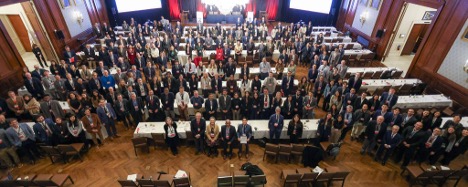
Group picture of attendees at the 50th Atlantic Coast Retina Club and Macula 2026 conference in Philadelphia during January 2026. Photo by Kevin Caldwell.
Medical Retina
Several presentations during the medical retina sessions highlighted emerging therapies alongside evolving approaches to established clinical challenges. A fascinating focus was the potential role of intravitreal tyrosine kinase inhibitors (TKIs) in diabetic retinopathy (DR) and DME. Katherine E. Talcott, MD, reviewed how TKIs act upstream of VEGF by inhibiting intracellular receptor signaling while also suppressing inflammatory mediators such as interleukin-6 (IL-6), in contrast to conventional anti-VEGF agents that target select VEGF isoforms. Early clinical data demonstrated visual acuity and central foveal thickness outcomes comparable to anti-VEGF therapy, with the potential advantage of fewer injections.
Other presentations reflected the breadth of medical retinal topics addressed during the meeting. Neil M. Bressler, MD, discussed treatment strategies in DR, noting similar visual outcomes with anti-VEGF monotherapy compared with combination anti-VEGF and panretinal photocoagulation (PRP), although PRP may be preferable in patients with limited follow-up. Adrienne W. Scott, MD, highlighted real-world deviations from DRCR Protocol S, emphasizing individualized decision-making in patients with good visual acuity despite OCT-confirmed macular edema.
Beyond diabetic disease, Richard B. Rosen, MD, ScD, presented the ROCKET protocol for central retinal artery occlusion, which leverages rapid OCT-based diagnosis to expedite care. Rishi P. Singh, MD, reviewed recent studies evaluating associations between GLP-1 receptor agonists and nonarteritic anterior ischemic optic neuropathy, neovascular AMD, and worsening DR, while also noting emerging data suggesting a potential protective effect in glaucoma.
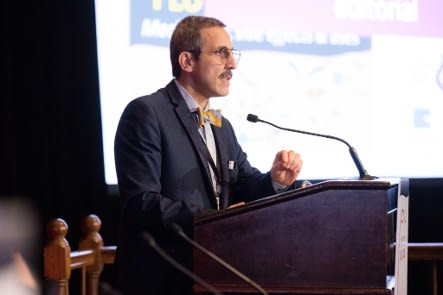
Demetrios G. Vavvas, MD, PhD, summarizes current and emerging pharmacologic approaches to proliferative vitreoretinopathy during the surgical retina session. Photo by Kevin Caldwell.
Surgical Retina
Presentations in the surgical retina sessions addressed technical refinements and unresolved controversies in vitreoretinal surgery. Donald J. D’Amico, MD, reviewed decision-making in macular hole surgery, emphasizing that for holes >400 µm, conventional internal limiting membrane (ILM) peeling achieves outcomes comparable to more complex techniques. Other talks focused on surgical judgment in complex scenarios, including a discussion of management options for dislocated posterior-chamber intraocular lenses (IOLs) by John T. Thompson, MD. He outlined the tradeoffs of each approach and highlighted IOL-preservation strategies aimed at reducing surgical trauma.
Yasha S. Modi, MD, addressed retinal displacement following rhegmatogenous retinal detachment repair, suggesting that avoiding overly aggressive fluid removal may help mitigate postoperative metamorphopsia. Talia R. Kaden, MD, revisited primary scleral buckling, reinforcing its role in young, phakic patients.
Another highlight was a summary of proliferative vitreoretinopathy (PVR) pharmacotherapy by Demetrios G. Vavvas, MD, PhD. He emphasized that PVR is a biologically heterogeneous disease, which limits the success of single-center studies and uniform treatment strategies. Although agents such as intravitreal methotrexate, topotecan, and mTOR inhibitors show promise, definitive evidence remains limited. Dr. Vavvas stressed that progress will depend on coordinated, multicenter collaboration with standardized endpoints to identify targetable pathways and move beyond the current therapeutic impasse.
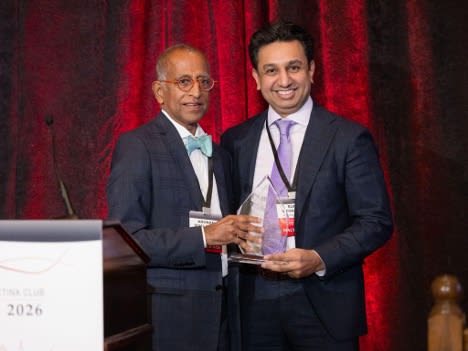
Atlantic Coast Retina Club and Macula 2026 conference co-organizer Arunan Sivalingam, MD, (left) with Sunil K. Srivastava, MD, who delivered the prestigious J. Arch McNamara Lecture. Photo by Kevin Caldwell.
Conclusion
The conference concluded with a tribute honoring leaders in retina whose scholarship, mentorship, clinical innovation, and unwavering dedication to patient care have shaped the subspecialty. This year’s distinguished honorees included William E. Benson, MD; Julia A. Haller, MD; Joan W. Miller, MD; Jerry A. Shields, MD; and Lawrence A. Yannuzzi, MD. They were recognized not only for their scientific contributions, but also for their lasting impact on trainees, colleagues, and the retina community. Each tribute was met by a heartfelt standing ovation.
Another highlight of the final day was the J. Arch McNamara Lecture, delivered by Sunil K. Srivastava, MD. He shared insights from his long-term multidisciplinary work caring for patients with Susac syndrome, an autoimmune vasculitis affecting the eyes, ears, and brain. These moments provided a fitting and reflective close to another successful ACRC meeting. RP