





The US Food and Drug Administration (FDA) has accepted and filed Nanoscope Therapeutics’ biologics license application (BLA) for sonpiretigene isteparvovec (Mogenry; MCO-010), an investigational optogenetic gene therapy for patients with retinitis pigmentosa (RP) and severe vision loss. According to the company, a Prescription Drug User Fee Act (PDUFA) date in the first half of 2027 has been issued, and the company is actively preparing to be commercial ready in the first half of 2027.
The filing follows more than a decade of development of Nanoscope’s multicharacteristic opsin platform. Unlike gene-replacement therapies directed at a specific disease-causing mutation, MCO-010 is designed to work independently of the genetic cause of RP. The one-time intravitreal therapy uses a viral vector to deliver a gene encoding a synthetic, broadband light-sensitive protein to surviving bipolar cells. By making these cells responsive to light, the approach is intended to use remaining retinal circuitry to partially compensate for photoreceptor loss. The treatment does not require genetic testing or subretinal surgery and is designed for administration in a retina office.
The BLA is supported by a phase 1/2a study and RESTORE, a randomized, double-masked, sham-controlled phase 2b/3 trial. According to Nanoscope, RESTORE met its primary and key secondary endpoints, with improvements in visual acuity at weeks 52 and 76. No treatment-related serious adverse events were reported. Long-term data from RESTORE participants who continued into the REMAIN extension study were also included in the application.
MCO-010 has received FDA Fast Track and Orphan Drug designations for RP. Nanoscope is also studying the platform in Stargardt disease and plans additional development in other retinal degenerative diseases, such as geographic atrophy. If approved, MCO-010 would be the first gene-agnostic therapy approved to improve vision in patients with RP and severe vision loss. RP
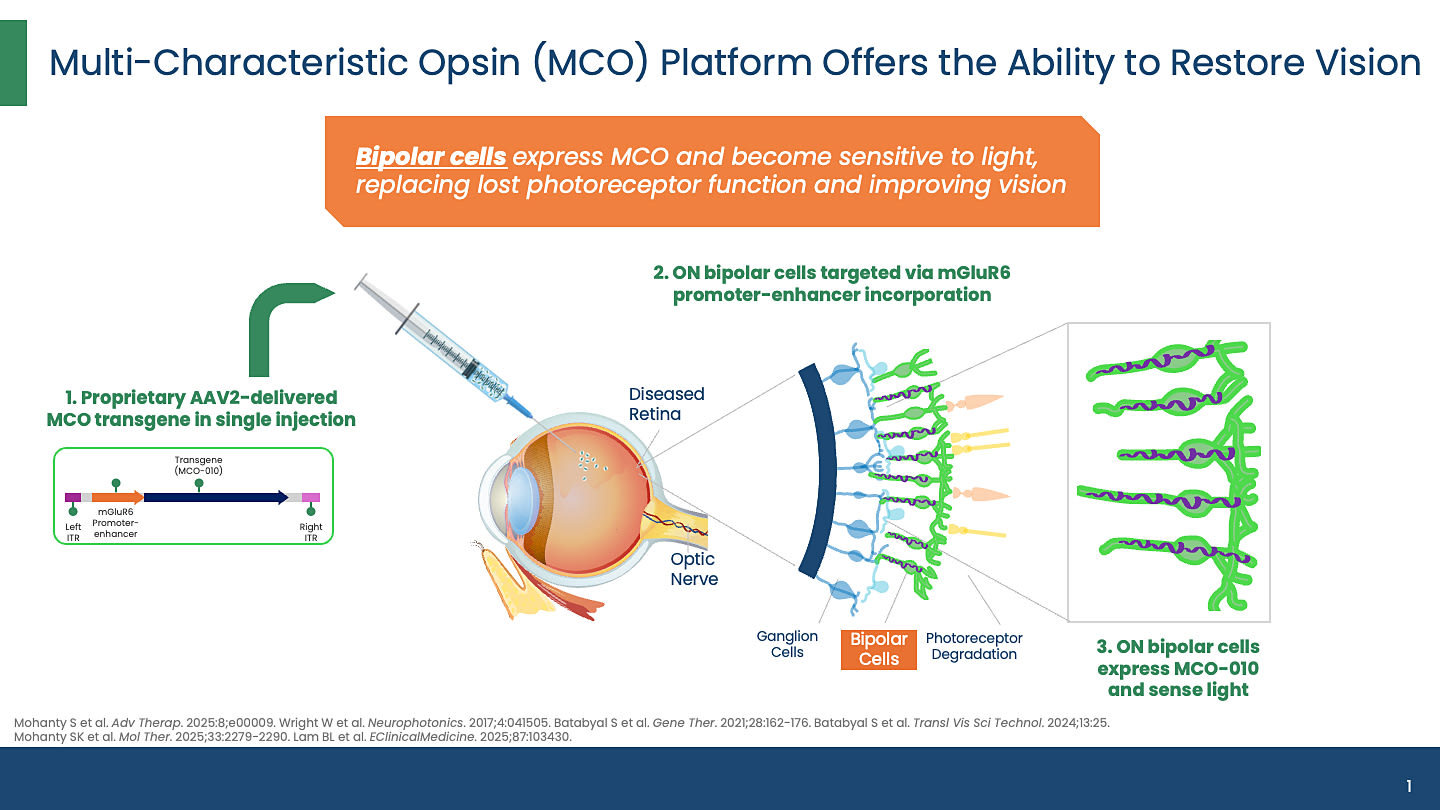
Figure 1. Multicharacteristic opsin (MCO) therapy delivers a gene encoding a bioengineered light-sensitive protein to ON bipolar cells, making these surviving retinal cells responsive to light. The approach is designed to restore visual function despite substantial photoreceptor loss in retinal degenerative diseases.