


Ocular tumor coding can be challenging because ocular oncology often involves evolving lesions, diagnostic uncertainty, and terminology that does not always translate cleanly into ICD-10-CM codes. Terms such as “suspicious lesion,” “pigmented mass,” or “possible melanoma” may reflect clinical concern, but diagnosis coding does not allow “rule-out” coding. Instead, the diagnosis code must reflect the condition documented at the time of the visit. Understanding how to distinguish benign, malignant, in situ, and uncertain histologic behavior neoplasms is essential for accurate coding, medical necessity, and audit defensibility.
Q: When should I use malignant (C69.-) vs benign (D31.-) vs uncertain behavior (D48.7) codes for ocular tumors?
A: The physician will use pathology or lab testing to make the definitive diagnosis. To assist in understanding, here are the definitions for each:
-
Benign refers to a noncancerous growth that usually stays localized, grows gradually, and does not invade nearby tissue.
-
In situ refers to a lesion in which cells show cytologic features of malignancy but remain confined above the basement membrane, without invading neighboring tissues. It is regarded as a preinvasive or noninvasive form of malignancy.
-
Malignant tumors are cancerous growths that invade nearby tissues, destroy local structures, and can spread to other parts of the body. They often grow uncontrollably and exhibit varying degrees of abnormal cell appearance.
-
Uncertain histologic behavior refers to a lesion for which the pathologic assessment cannot conclusively determine whether the neoplasm is benign or malignant.
Q: Should I code both the primary cancer and the ocular metastasis?
A: The confirmed primary cancer will typically be treated by another clinician, who will provide the correct diagnosis code based on the site and histology. The primary site will be coded as the second diagnosis, with the ocular tumor as the first diagnosis code for the retinal physician, because that is what is being treated.
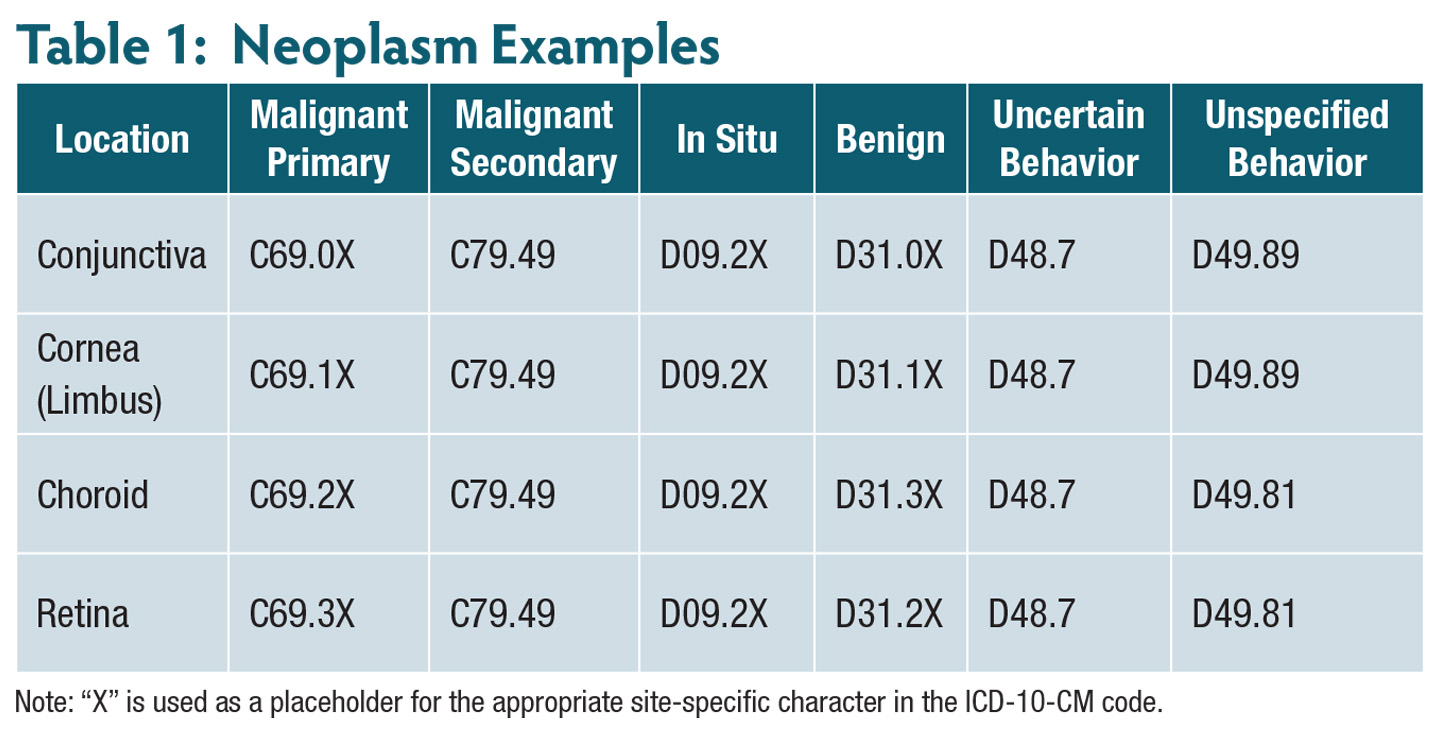
The Table of Neoplasms provides the suggested ICD-10 code; however, always review the code to verify accuracy and select the diagnosis code with the highest specificity. Some examplesare found in Table 1.
Q: When an ocular tumor involves several anatomical sites in the eye, such as the choroid and the orbit, should separate diagnosis codes be assigned for each anatomical site involved?
A: If the tumor is considered the primary malignant neoplasm, the applicable categories for malignant neoplasms of the eye and adnexa are listed below. The missing fifth character (denoted by X) is: 1, right eye; 2, left eye; or 0, unspecified eye.
-
C69.0X Malignant neoplasm of conjunctiva
-
C69.1X Malignant neoplasm of cornea
-
C69.2X Malignant neoplasm of retina
-
C69.3X Malignant neoplasm of choroid
-
C69.4X Malignant neoplasm of ciliary body
-
C69.5X Malignant neoplasm of lacrimal gland and duct
-
C69.6X Malignant neoplasm of orbit
-
C69.8X Malignant neoplasm of overlapping sites of eye and adnexa
-
C69.9X Malignant neoplasm of unspecified site of eye
If the sites overlap in the eye, “C69.8X Malignant neoplasm of overlapping sites of eye and adnexa” is most appropriate.
However, for secondary tumors, ICD-10-CM uses a more general code because the eye is classified within the nervous system. In that case, “C79.49 Secondary malignant neoplasm of other parts of the nervous system” should be used
Q: What are common documentation deficiencies that create coding and audit vulnerability in ocular oncology encounters?
A: Common documentation deficiencies in ocular oncology often involve a lack of specificity and insufficient clinical support for treatment decisions. Frequent issues include the following:
-
Failing to document whether the lesion is benign, malignant, suspicious, in situ, or of uncertain behavior.
-
Using vague terms such as “ocular mass” or “pigmented lesion” without diagnostic clarification.
-
Lacking anatomical specificity, laterality, or lesion characteristics.
-
Failing to compare with prior imaging or previous exams.
-
Cloning documentation across visits without evidence of reassessment.
-
Failing to explain why the lesion warrants observation, testing, referral, or treatment.
-
Failing to distinguish primary ocular malignancy from metastatic disease
In audits, ocular tumor documentation is often reviewed longitudinally, so repetitive or nonspecific notes across multiple visits can create compliance risk even when an individual note appears adequate. RP