


The following transcript has been edited for clarity.
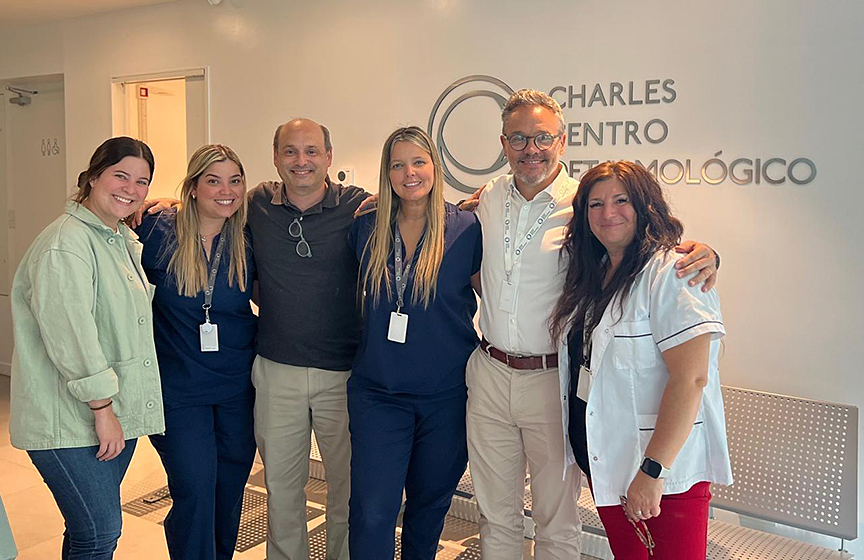
Patricio G. Schlottmann, MD: Hello again from Ushuaia, Argentina. I am with two friends. First question for you—how is the meeting in Ushuaia going for you?
Yijun Huang, PhD: Wonderful, fascinating. The scenery in Argentina is beautiful and mesmerizing, and the meeting has also been very enlightening. We’ve really enjoyed the opportunity to work with our Argentinian colleagues in the field of ophthalmology, and thank you for the invitation.
Dr. Schlottmann: Our pleasure. And you, David?
David P. Bingaman, DVM, PhD, DACVO: Third time to Argentina, but first time to Ushuaia. Fantastic fellowship—food, wine, helicopter ride to the top of the end of the world. Fantastic.
Dr. Schlottmann: Excellent, excellent. So I have more questions for you. Most of us work in clinical trials. We recruit patients for companies trying to prove that the drug is good enough. And that means dealing with reading centers, which do the reading and evaluation of the images in a masked fashion. And it is very important because this is one of the key decision-making points for treatment within the clinical trial. So you are representing Merit here, which is one of the most appreciated reading centers for us. What can you tell us about Merit?
Dr. Huang: Thank you for the question. Merit is a U.S. company. We are specialized as a reading center, and we have done a lot in the field of ophthalmology. The reading center is an important element in the clinical trials, because when you are dealing with multisite global clinical trials, you require an independent body to bring those data together and to review those data in a blinded, independent fashion. And that’s what Merit does.
But in addition to bringing all the medical data together, a reading center actually does a little bit more. And Merit does quite a bit more than just grading images. We really have to deal with how to interface with the site and bring those data together. We use a technology platform to allow all the stakeholders to review the data and see how the data have been put together, as well as to provide an audit trail to make sure every point is being checked. This last piece is the quality assurance.
We are very pleased to have an opportunity to participate in many of the trials that are done in Argentina, and we very much appreciate our interactions with your site.
Dr. Schlottmann: It’s a pleasure for us because Merit is a really good reading center to work with. The Excelsior platform is really good.
David, I have a question for you. Tomorrow, we’re going to have a research session, and Merit is going to be presenting some new endpoints. What can you tell us about that?
Dr. Bingaman: On one panel, we’ll be discussing what sponsors look for in clinical research sites. We can comment on that because last year we were involved in just over 200 ophthalmology clinical trials globally. Interestingly, 45 of those were done in China with our wholly owned Merit China subsidiary.
In addition, we’ll be talking about several artificial intelligence (AI)–based endpoints. We have a very unique way of looking at the en face optical coherence tomography (OCT) image, and we’ll be speaking about how that relates to a variety of dry age-related macular degeneration (AMD) endpoints, whether it be total lesion area for geographic atrophy (GA) or, in high-risk intermediate AMD, hyperreflective foci, drusen volume, and choroidal hypertransmission defects.
Dr. Schlottmann: That’s excellent. That’s very interesting. Looking forward to that presentation tomorrow. It’s a pleasure for us to work with Merit and also to have you here in Ushuaia, Argentina. Thank you very much. RP