




Changes in the spectrum, intensity, and timing of light exposure may be contributing to the rising prevalence of myopia, according to Francine Behar-Cohen, MD, PhD, who reviewed evidence linking artificial lighting, outdoor activity, and circadian rhythms to ocular growth.
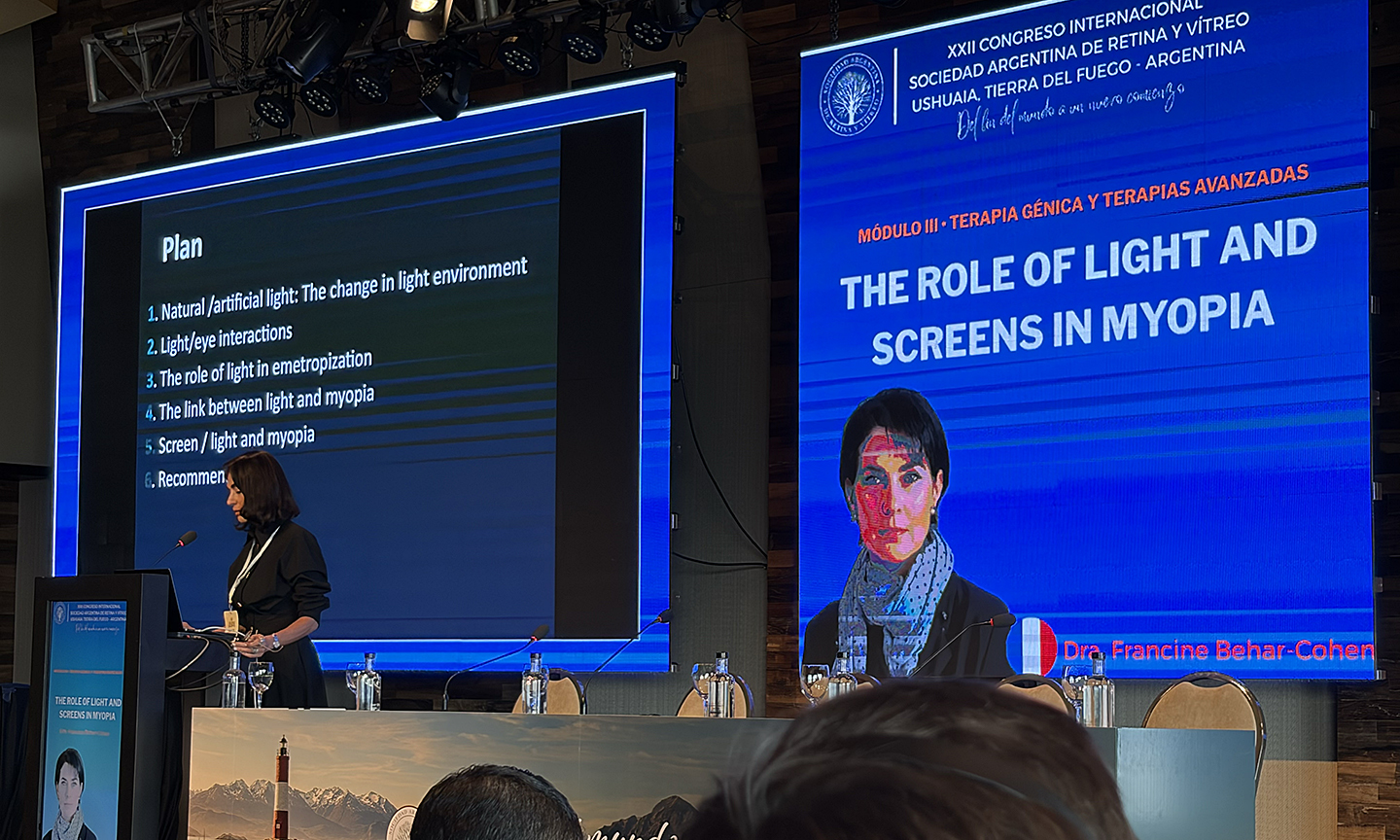
Dr. Behar-Cohen, a professor of ophthalmology at Université de Paris Cité and director of a research team at the Centre de Recherche des Cordeliers, discussed the findings during the 2026 meeting of the Argentine Society for Retina and Vitreous in Ushuaia, Argentina. Her presentation, “The Role of Light and Screens in Myopia,” examined how changes in the light environment may influence emmetropization and myopia progression.
The increasing prevalence of myopia has important public health implications. Dr. Behar-Cohen said that myopia affected 35.8% of children and adolescents worldwide in 2023, and its global prevalence is projected to approach 50% by 2050.1 She highlighted research on the ocular complications associated with high myopia. For example, a 2025 study found significant differences in retinal and choroidal structure between highly myopic eyes and those with mild to moderate myopia, including reduced choroidal thickness and choriocapillaris density.2 Against this background, she identified insufficient exposure to natural light during childhood as an important, potentially modifiable environmental risk factor for myopia.
The Changing Light Environment
Light is characterized by its correlated color temperature, measured in kelvins (K), which describes whether a white light source appears warmer (more yellow or reddish) or cooler (more bluish). For example, light at 3000 K has a warmer appearance, whereas light at 6000 K appears cooler.
Related Content
Natural daylight offers a continuous spectrum that changes throughout the day, explained Dr. Behar-Cohen. “We have all the colors of light, and the variation in the spectrum depends on the time of day. During the morning, we have more blue, and as the day goes on, we have more red.”
On the other hand, the artificial lighting used today is very different from natural light. Incandescent lighting, which produces a continuous spectrum rich in red wavelengths, has largely been replaced by more energy-efficient light sources, said Dr. Behar-Cohen. These newer lighting technologies, including fluorescent and LED lights, typically produce a prominent blue peak and a broader emission band at longer wavelengths with less red light.
These changes are part of a broader shift in the human light environment, she observed. More than 80% of the world’s population—including more than 99% of people in Europe and the United States—live under light-polluted skies. Artificial illumination has altered not only the spectral composition of light exposure but also its intensity and timing, extending exposure beyond natural daylight hours and disrupting traditional light-dark cycles.
“The spectrum has changed. The intensity has changed. The amount of light that we have everywhere has increased,” said Dr. Behar-Cohen. “We have changed our light environment.”
Light’s Role in Myopia Development
Dr. Behar-Cohen reviewed research suggesting that the spectral composition and temporal characteristics of light may influence emmetropization, the process by which the developing eye regulates its growth to achieve appropriate focus. Because different wavelengths of light focus at different positions within the eye, longitudinal chromatic aberration provides visual signals that may help regulate axial elongation. Experimental studies have demonstrated that the effects of light exposure on ocular growth depend on wavelength, contrast, and temporal frequency.3-6
Light exposure is one of several influences on refractive development, though Dr. Behar-Cohen emphasized that it is “not the only factor. Genetic factors, food, and all this are combined in a very complex environment.”
Evidence supporting outdoor activity as a preventive intervention is more established. Dr. Behar-Cohen reviewed observational and interventional studies associating increased outdoor exposure with reduced myopia onset in children.7-12 She noted that studies comparing children engaged in similar activities indoors and outdoors suggest that the protective effect cannot be explained solely by differences in visual tasks. “Time outdoors is important,” she said. “If you look at these experiments, and you look at what we have created with high light pollution, we have created a myopigenic environment.”
Dr. Behar-Cohen remarked on the irony that low-level red-light therapy is now used to treat myopia in children. “We have changed the environment, and now we have to pay to put children under the light.”
The Effects of Light at Night
Dr. Behar-Cohen also discussed the effects of artificial light exposure on circadian rhythms, particularly as the widespread use of electronic devices has extended light exposure into nighttime hours. Smartphones, computers, and television screens expose users to light at times when natural illumination would ordinarily be declining or absent, potentially disrupting the body's normal light-dark cycle.
She noted that nighttime screen exposure may be particularly problematic for children because light can influence circadian timing and sleep patterns. Even relatively low levels of illumination can produce measurable circadian responses, depending on the intensity, duration, timing, and spectral composition of the exposure.
Dr. Behar-Cohen also described work with the French Agency for Food, Environmental and Occupational Health & Safety (ANSES) to model light exposure under different environmental conditions, including office settings. These assessments help illustrate how artificial lighting and screen use contribute to cumulative daily light exposure and alter the timing and spectral characteristics of the light people receive, she explained.
Recommendations to Prevent Myopia
Dr. Behar-Cohen recommended increasing children’s exposure to natural daylight, particularly by encouraging outdoor activities. She cited recommendations that children spend at least 11 hours per week outdoors, noting that time outside may help reduce the risk of developing myopia. She also suggested maximizing natural light in indoor environments, such as positioning children's workspaces near windows rather than relying exclusively on artificial lighting. She observed that existing lighting standards are largely designed around adult occupational environments and may not adequately address children's needs.
She also recommended limiting children's screen exposure, particularly in the hours before bedtime. Although she acknowledged that reducing screen use can be difficult given the prevalence of electronic devices in children's daily lives, she emphasized the importance of maintaining regular sleep schedules and minimizing artificial light exposure at night. These measures may help preserve normal circadian rhythms while reducing some of the environmental exposures potentially associated with myopia development. RP
References
1. Holden BA, Fricke TR, Wilson DA, et al. Global prevalence of myopia and high myopia and temporal trends from 2000 through 2050. Ophthalmology. 2016;123(5):1036-1042. doi:10.1016/j.ophtha.2016.01.006
2. Chen Q, Song K, Cun Q, et al. Differences in macular structure and microvasculature between high myopia and non-high myopia. Front Med (Lausanne). 2025;12:1645015. doi:10.3389/fmed.2025.1645015
3. Rucker F, Henriksen M, Yanase T, Taylor C. The role of temporal contrast and blue light in emmetropization. Vision Res. 2018;151:78-87. doi:10.1016/j.visres.2017.07.003
4. Rucker FJ, Eskew RT Jr, Taylor C. Signals for defocus arise from longitudinal chromatic aberration in chick. Exp Eye Res. 2020;198:108126. doi:10.1016/j.exer.2020.108126
5. Gawne TJ, Grytz R, Norton TT. How chromatic cues can guide human eye growth to achieve good focus. J Vis. 2021;21(5):11. doi:10.1167/jov.21.5.11
6. She Z, Gawne TJ. The parameters governing the anti-myopia efficacy of chromatically simulated myopic defocus in tree shrews. Transl Vis Sci Technol. 2024;13(5):6. doi:10.1167/tvst.13.5.6
7. French AN, Ashby RS, Morgan IG, Rose KA. Time outdoors and the prevention of myopia. Exp Eye Res. 2013;114:58-68. doi:10.1016/j.exer.2013.04.018
8. Wu PC, Chen CT, Lin KK, et al. Myopia prevention and outdoor light intensity in a school-based cluster randomized trial. Ophthalmology. 2018;125(8):1239-1250. doi:10.1016/j.ophtha.2017.12.011
9. De La Puente M, Irigoyen-Bañegil C, Dosal-Franco M, et al. More sun, less myopia: validating CUVAF as a biomarker for outdoor exposure in a cohort of Spanish schoolchildren. Front Med (Lausanne). 2026;13:1708836. doi:10.3389/fmed.2026.1708836
10. Jones LA, Sinnott LT, Mutti DO, Mitchell GL, Moeschberger ML, Zadnik K. Parental history of myopia, sports and outdoor activities, and future myopia. Invest Ophthalmol Vis Sci. 2007;48(8):3524-3532. doi:10.1167/iovs.06-1118
11. Rose KA, Morgan IG, Ip J, et al. Outdoor activity reduces the prevalence of myopia in children. Ophthalmology. 2008;115(8):1279-1285. doi:10.1016/j.ophtha.2007.12.019
12. Li M, Lanca C, Tan CS, et al. Association of time outdoors and patterns of light exposure with myopia in children. Br J Ophthalmol. 2023;107(1):133-139. doi:10.1136/bjophthalmol-2021-318918